The picture of the world that’s presented to the public has only the remotest relation to reality.
Noam Chomsky
This is Part 1 of a 3 part series on The Manufacturing Consent for a Genocide. Part 2 can be found here and Part 3 can be found here. All sources that were utilized in writing this 3 part series can be found at the end of part 3. All three parts can be read as one single article here
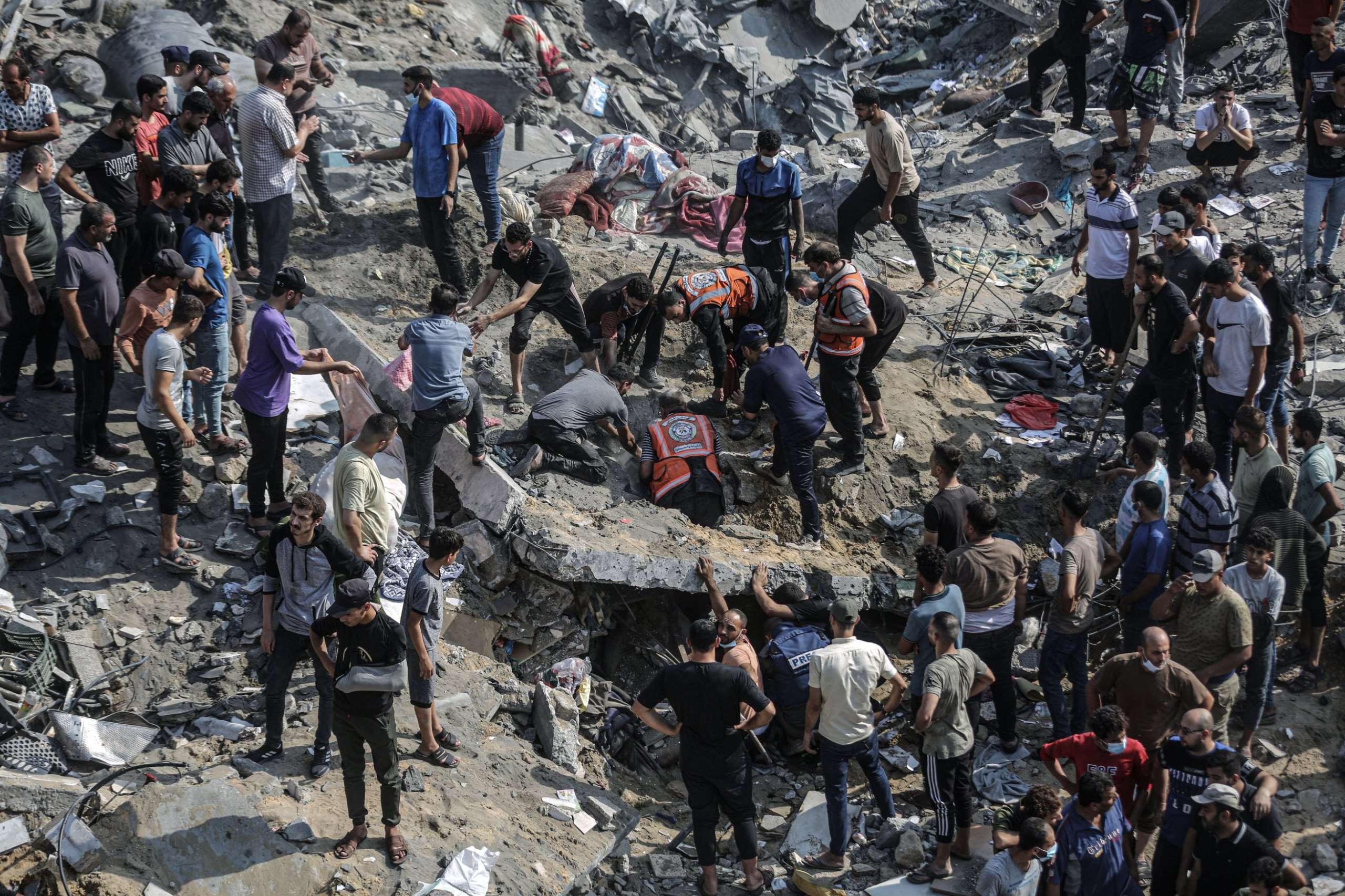
The scale of devastation in Gaza is unparalleled in recent history. The entire northern half of the region lies in ruins, a stark testament to the severity of the assault. It’s evident that hospitals have been specifically targeted, their ruins a grim indicator of the conflict’s brutality. Residential apartment buildings and homes have been reduced to rubble, and even essential facilities like bakeries and mosques have not been spared, bombed in a relentless campaign of destruction. Refugee camps, which are densely populated areas filled with refugees from the 1948 Nakba, the 1967 occupation of Gaza, and other Israeli offensives in Gaza that destroyed civilian homes.

Seven weeks of hostilities in Gaza and Israel have taken an appalling toll that has shocked the world
Stéphane Dujarric – UN spokesperson
Over 15,000 women, children, and men have been killed. 70% of the killed are women and children. Among the 15,000 killed, 6000 have been children. This is greater than the yearly global totals for children killed in conflict zones for the past three years, as tallied by the UN. “Gaza is becoming a graveyard for children,” UN Secretary-General António Guterres warned earlier this month. More that 60% of the 2.3 million Palestinians in Gaza have have been displaced due to the destruction or damage their home and the IDF displacement order.
In this exploration of the Gaza offensive, a critical lens is turned towards the concept of ‘Manufacturing Consent.’ Originally coined to describe the subtle yet powerful ways in which media and political narratives shape public opinion, this notion takes on a stark and urgent relevance in the context of Gaza. Here, ‘Manufacturing Consent’ is not just a theory but a palpable force, where orchestrated narratives and media portrayal play a pivotal role in shaping global understanding and response to the conflict.
This article examines the intricate interplay of media narratives, political rhetoric, and public perception, and how they collectively contribute to the normalization and justification of the violence in Gaza. It seeks to unravel the nuanced ways in which these elements align to create a discourse that, intentionally or not, serves to mitigate the perceived severity of the conflict, thereby shaping a global understanding that tacitly accepts or even endorses the ongoing hostilities.
Table of Contents
Background and Context
It is critical to note that this conflict did not begin on October 7th by the heinous attack on civilians by Hamas. Just as Hamas is to be criticized for these actions, Israel needs to be criticized for their actions prior to October 7th, going back 75 years. For a high level background on the Palestine – Israel conflict, please review the article entitled An Examination of Apartheid in Israel. Below is a short summary to provide context to this article.
The Israel-Palestine conflict, steeped in decades of historical, political, and territorial disputes, serves as the backdrop for the latest offensive in Gaza. This enduring conflict traces its roots to the early 20th century, marked by a long-standing contention over land and sovereignty between Jewish settlers and the indigenous Palestinian population in the region. The establishment of Israel in 1948 and subsequent Nakba where 750,000 Palestinians were driven out of their homes violently, as well as the the 1967 war, significantly shaped the current boundaries and the ongoing state of tension and conflict.
In recent times, the situation has been further inflamed by a series of events that have escalated tensions to new heights. The expansion of Israeli settlements in the Palestinian West Bank, the unending siege and sanctions on Gaza, the large number of Palestinian political prisoners in Israeli prisons, the Israeli apartheid system, and recurrent cycles of violence have all contributed to the mounting strain. The latest offensive in Gaza is a culmination of these simmering tensions, sparked by the actions on October 7th that ignited this latest round of widespread violence.
At the heart of this conflict are key players whose actions and decisions continue to drive the narrative. The right wing, nationalist Israeli government, with its military superiority, apartheid system, and political strategies, plays a central role. On the other side is governing party in Gaza, Hammas, as well as other Palestinian resistance factions. The complexity of the situation is further compounded by international stakeholders — including the United States, the United Nations, and non-governmental organizations — each bringing their own interests and perspectives to a conflict that is both deeply local and undeniably global. Understanding the roles and motivations of these players is crucial in comprehending the nuances and dynamics of the ongoing crisis.
Defining a Genocide
Understanding the definition of genocide is vital in dissecting the Israel-Gaza conflict. It frames our analysis within an established legal and ethical context, allowing for a more nuanced examination of the actions and their implications against internationally recognized standards.
The United Nations defined the crime of genocide in Article II of the Genocide Convention. Genocide is defined in the same terms as in the Genocide Convention in the Rome Statute of the International Criminal Court, Others have defined genocide as well. The UN defines it as follows:
Article II
In the present Convention, genocide means any of the following acts committed with intent to destroy, in whole or in part, a national, ethnical, racial or religious group, as such:
- Killing members of the group;
- Causing serious bodily or mental harm to members of the group;
- Deliberately inflicting on the group conditions of life calculated to bring about its physical destruction in whole or in part;
- Imposing measures intended to prevent births within the group;
- Forcibly transferring children of the group to another group.
The entire UN resolution can be downloaded below.
The “intent to destroy” is a requirement of a genocide. The UN also states: The intent is the most difficult element to determine. To constitute genocide, there must be a proven intent on the part of perpetrators to physically destroy a national, ethnical, racial or religious group
In summary, there are two aspects that need to occur in order for it to be categorized as genocide: an intent and the execution.
With this definition as our guide, we will scrutinize Israel’s actions to ascertain whether they meet the criteria of genocide, both in intent and execution.
Intent to Destroy
Typically, the intent to destroy has been the most complex to ascertain. However, Israeli leadership has simplified this for us.
It’s an entire nation out there that is responsible. This rhetoric about civilians not aware, not involved, it’s absolutely not true. They could’ve risen up, they could have fought against that evil regime.
Isaac Herzog, Israeli President
Herzog is indicating that the entire Palestinian population is responsible for the October 7th attack making them fair game in war stating an intent to destroy the Palestinian people.
“Right now, one goal: Nakba! A Nakba that will overshadow the Nakba of 1948,”
Ariel Kallner, a member of the Israeli parliament
In the above quote, Kallner is calling for another Nakba. Another mass displacement and mass killing of the Palestinians. Again clearly demonstrating the intent to destroy.
We are now rolling out the Gaza Nakba. Gaza Nakba 2023. That’s how it’ll end.
Avi Dichter, Israeli security cabinet member
In his invocation of the term ‘Nakba,’ an Arabic word signifying ‘catastrophe,’ Dichter draws a rhetorical parallel between Israel’s current offensive against the 2.3 million inhabitants of Gaza, of which 1 million are children, and the historic events of 1948. That year marked Israel’s acquisition of over three-quarters of Palestine, a process characterized by the violent displacement of about 75 percent of the indigenous Palestinian population from their ancestral lands in the territories that formed the new Israeli state. This upheaval was compounded by the systematic destruction of numerous Palestinian villages, towns, and cities, a strategic move aimed at thwarting the possibility of Palestinian refugees returning to their homes.
This deliberate linkage by Dichter and others not only recalls a painful historical episode but also directly suggests an ‘intent to destroy,’ a critical component in the definition of genocide. The parallel drawn between the historic dispossession and displacement of Palestinians and the current military actions in Gaza implies a continuity of purpose. This continuity, when viewed through the lens of the Genocide Convention, raises profound questions about the objectives underlying these military campaigns and whether they constitute a sustained effort aimed at the physical and cultural dismantling of a people.
Still more statements from Israeli leadership can point to an ‘intent to destroy’
Yoav Gallant, Israel’s defense minister ordered a “complete siege” of Gaza When Israel’s defence minister, Yoav Gallant, ordered a “complete siege” of the Gaza Strip with “no electricity, no food, no fuel, everything is closed”, he said: “We are fighting human animals and we are acting accordingly.”
Although there are many more statements that can point to the intent to destroy, we will end with one final statement from Prime Minister Benjamin Netanyahu:
You must remember what Amalek has done to you, says our Holy Bible. 1 Samuel 15:3 ‘Now go and smite Amalek, and utterly destroy all that they have, and spare them not; but slay both man and woman, infant and suckling, ox and sheep, camel and ass’,
Benjamin Netanyahu, Israeli Prime Minister
This statement by Prime Minister Benjamin Netanyahu, referencing a biblical directive against Amalek, can be interpreted as signaling an ‘intent to destroy.’ The scriptural invocation to ‘utterly destroy’ and spare no one, applied in the context of modern conflict, resonates with ominous implications. It suggests a perspective that aligns with the criteria of intent as outlined in the Genocide Convention, raising serious concerns about the underlying motivations of the Israeli leadership’s policies and actions in Gaza.
The Execution of the Acts of Genocide
Having established the ‘intent to destroy,’ our focus now shifts to the execution of acts that may constitute genocide. This section will critically examine whether the actions unfolding in Gaza align with the internationally recognized definition of genocide, as previously outlined. It is imperative to scrutinize the specific actions in light of these criteria to ascertain if they indeed meet the threshold of genocidal acts under international law
As stated above the definition of genocide would require any of the following occurring to a part or entire Palestinian population:
- Killing members of the group;
- Causing serious bodily or mental harm to members of the group;
- Deliberately inflicting on the group conditions of life calculated to bring about its physical destruction in whole or in part;
- Imposing measures intended to prevent births within the group;
- Forcibly transferring children of the group to another group.
Killing Members of the group – It is indisputable that members of the population have been killed indiscriminately. Over 15,000 people have been killed, with 75% of the killed women and children. According to the Washington Post, 1 out of every 200 children in Gaza have been killed.

The nature of the weaponry also brings to light the intension and execution of Israeli offensive. According to the New York Times:
“Israel’s liberal use of very large weapons in dense urban areas, including U.S.-made 2,000-pound bombs that can flatten an apartment tower, is surprising, some experts say.
“It’s beyond anything that I’ve seen in my career,” said Marc Garlasco, a military adviser for the Dutch organization PAX and a former senior intelligence analyst at the Pentagon. To find a historical comparison for so many large bombs in such a small area, he said, we may “have to go back to Vietnam, or the Second World War.” For more details about the weaponry and destruction by Israeli weapons, please refer to this link.
Serious bodily and mental harm has also occurred. Prisoners and hostages have been killed and beaten.
Israeli settlers regularly attack Palestinians families and homes in the West Bank.
Deliberately inflicting on the group conditions of life calculated to bring about its physical destruction in whole or in part – Again this is indisputable. Gaza has been bombed to the ground. Conditions are unlivable. All aspects of life have been impacted. Homes destroyed, airstriking mosques, hospitals bombed, bakeries destroyed, even refugee camps were the most vulnerable live were not spared.


In light of the evidence presented, including the indiscriminate killing of civilians, the deployment of disproportionately destructive weaponry in densely populated areas, and the systematic destruction of essential infrastructure, it becomes increasingly clear that the actions in Gaza align disturbingly with the criteria for genocide as outlined by international law. These acts, far from being random or isolated incidents of violence, appear to constitute a concerted effort that inflicts both physical and psychological harm on the Palestinian population, thereby meeting the threshold of genocidal acts under the stringent standards of international jurisprudence.
The 10 Stages of Genocide
Another method of evaluating a genocide is to look at the 10 staged process of genocide as defined at GenocideWatch.com. Below each stage is defined (with definitions from GenocideWatch.com) along with a discussion of each in light of the Israeli occupation of Palestine:
Classification – One of most important classifications in the current nation-state system is citizenship in a nationality. Removal or denial of a group’s citizenship is a legal way to deny the group’s civil and human rights.
Palestinians in Gaza and the West Bank do not have any ability to attain Israeli citizenship. While Palestinians in Israel proper can become citizens are denied nationality and have reduced rights compared to Jewish citizens. See An Examination of Apartheid in Israel for more details. Palestinians are prevented access to Jewish areas and denied freedom of movement, often required to go through checkpoints while Jews do not have to go through checkpoints.
Symbolization – When combined with hatred, symbols may be forced upon unwilling members of pariah groups: the yellow star for Jews under Nazi rule, the blue scarf for people from the Eastern Zone in Khmer Rouge Cambodia.
I am not aware of Symbolization taking place in Israel or the occupied Palestinian territories.
Discrimination – A dominant group uses law, custom, and political power to deny the rights of other groups. The powerless group may not be accorded full civil rights, voting rights, or even citizenship. The dominant group is driven by an exclusionary ideology that would deprive less powerful groups of their rights. The ideology advocates monopolization or expansion of power by the dominant group. It legitimizes the victimization of weaker groups.
This is clearly evident in the stealing of land in the West Bank, the impermissibility of Palestinians to build homes in the West Bank, the military style checkpoints and other forms of apartheid.
Dehumanization – One group denies the humanity of the other group. Members of it are equated with animals, vermin, insects or diseases. Dehumanization overcomes the normal human revulsion against murder.
This is clearly evident in the language when describing Palestinians (“human animals”). In addition, the treatment of Palestinians by the IDF and settlers certainly is dehumanizing. The massive killing of children in Gaza also exemplifies this. See the video below that shows how Israeli settlers throw garbage at Palestinians.
Organization – Genocide is always organized, usually by the state, often using militias to provide deniability of state responsibility
Settlers are provided weapons and often encouraged by the IDF to attack Palestinian neighborhoods.
Polarization – Extremists drive the groups apart. Hate groups broadcast polarizing propaganda.
The right wing party led by Benjamin Netanyahu spews polarizing propaganda. Even centralist Israeli Jews are punished for showing remorse for the Palestinians.
Preparation – National or perpetrator group leaders plan the “Final Solution” to the Jewish, Armenian, Tutsi or other targeted group “question.” They often use euphemisms to cloak their intentions, such as referring to their goals as “ethnic cleansing,” “purification,” or “counter-terrorism.”
750,000 Palestinians have already been displaced from their homes in the 1948 Nakba, then again in 1967 after Israel took control of additional Palestinian land. Israeli officials have already pushed 1.3 million Palestinians out of the north of Gaza after October 7th and many officials have discussed moving all Palestinians to Sinai in Egypt.
Persecution – Victims are identified and separated out because of their national, ethnic, racial or religious identity. The victim group’s most basic human rights are systematically violated through extrajudicial killings, torture and forced displacement.
Israel regularly “mows the lawn” in Gaza and the West Bank, killing thousands of Palestinians and destroying infrastructure.
Extermination – Extermination begins, and quickly becomes the mass killing legally called “genocide.” It is “extermination” to the killers because they do not believe their victims to be fully human.
We’ve already have shown extensive examples of the extermination that is currently occurring in Gaza.
Denial – Denial is the final stage that lasts throughout and always follows genocide. It is among the surest indicators of further genocidal massacres. The perpetrators of genocide dig up the mass graves, burn the bodies, try to cover up the evidence and intimidate the witnesses.
Israel denies the genocide and claims that they are not targeting civilians. However, evidence shows otherwise. There is also evidence of Israel digging up mass graves as per this definition of Denial.
This analysis, using the 10 stages of genocide, paints a deeply concerning picture of the situation in Palestine under Israeli occupation. Each stage, from systematic rights denial to signs of extermination, aligns disturbingly with events on the ground. Despite clear indicators, the stage of denial is prevalent in official narratives, complicating acknowledgment and resolution. This evaluation not only highlights the severity of the crisis but also underscores the need for immediate international attention and intervention.”
Opinions of Genocide Scholars
Raz Segal – is an associate professor of Holocaust and genocide studies at Stockton University and the endowed professor in the study of modern genocide.
Raz Segal stated:”Indeed, Israel’s genocidal assault on Gaza is quite explicit, open, and unashamed. Perpetrators of genocide usually do not express their intentions…”
He also stated regarding Galant’s statement above: “Gallant’s orders on October 9th were no less explicit. Israel’s goal is to destroy the Palestinians of Gaza. And those of us watching around the world are derelict in our responsibility to prevent them from doing so.”
In addition to Segal, 790 scholars and practitioners of international law, conflict studies and genocide studies signed a public statement warning of the possibility of genocide being perpetrated by Israeli forces against Palestinians in the Gaza Strip. The full statement can be read below:
The insights from genocide scholars like Raz Segal, combined with the collective voice of 790 experts in international law, conflict studies, and genocide studies, lend a weighty academic and legal perspective to the situation in Gaza. Their unequivocal statements and the stark warning of potential genocide by Israeli forces against Palestinians underscore the gravity of the crisis. This collective consensus among experts not only validates the concerns raised in this analysis but also highlights the urgent need for global awareness and intervention.
As we transition to discussing the concept of manufacturing consent, it is imperative to reflect on these scholarly insights and their implications for understanding and addressing the conflict.



Leave a Reply