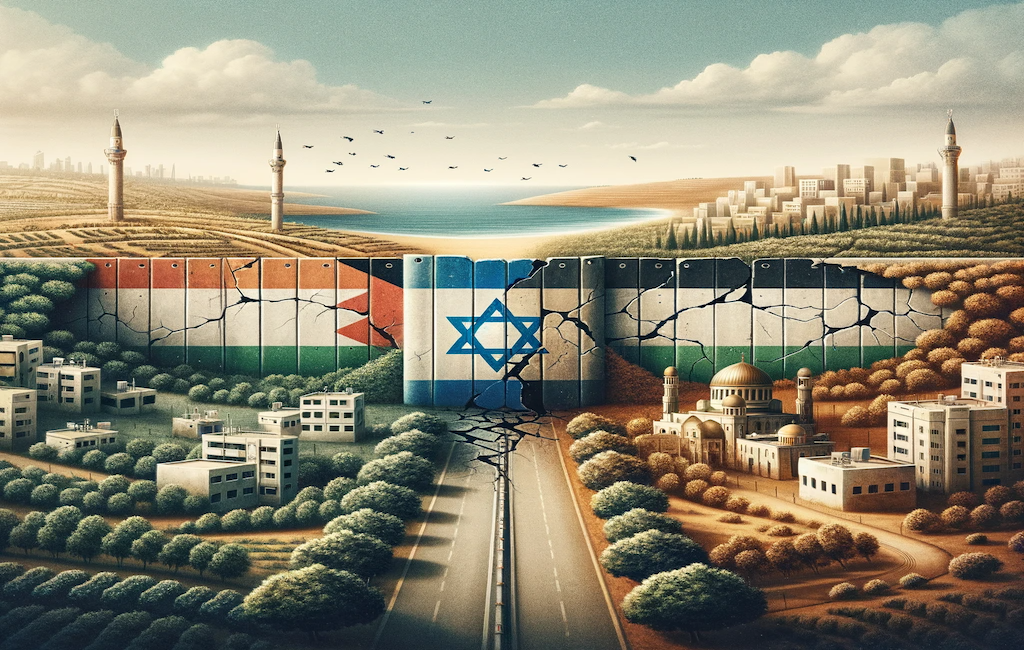
“If you are neutral in situations of injustice, you have chosen the side of the oppressor. If an elephant has its foot on the tail of a mouse, and you say that you are neutral, the mouse will not appreciate your neutrality.”
– Desmond Tutu, South African Archbishop
“Injustice anywhere is a threat to justice everywhere,” Martin Luther King Jr. once said, echoing a sentiment powerfully expressed by South African Archbishop Desmond Tutu (quoted above).
This notion of moral responsibility in the face of oppression provides a critical lens through which to examine historical and contemporary forms of apartheid. From South Africa’s notorious segregation policies to the Jim Crow laws in the United States, and the brutalities of Germany’s colonization in West Africa, history is replete with stark examples of segregation, persecution, and institutionalized racism. These episodes, universally condemned, serve as grim reminders of humanity’s capacity for oppression and the crucial need for vigilance and action against such injustices.
Today, a similarly grave question confronts the global community: Does the state of Israel, in its relationship with the Palestinian people, meet the criteria of an apartheid state? This article aims to dissect this complex and contentious issue. We will delve into independent research from human rights organizations, analyze statements from world leaders, and scrutinize facts gathered from the ground to offer a comprehensive perspective on this deeply divisive topic.
History of Israel
It is imperative to have a brief discussion about history of the Israel-Palestinian conflict in order to answer the question at hand.
The Balfour Declaration: Seeds of Discord
In the annals of history, few documents have reshaped the destiny of a land as profoundly as the Balfour Declaration of 1917. British Foreign Secretary Arthur Balfour’s promise to Lionel Walter Rothschild, a leader in the Zionist movement, was not merely a statement of support for a Jewish national home in Palestine; it was a harbinger of seismic shifts in the region’s future. At the time, the Jewish population was a mere fraction of the total, yet this declaration set the stage for a dramatic alteration of Palestine’s cultural and demographic tapestry.

The UN Partition Plan: A Divisive Blueprint
The United Nations’ 1947 partition plan was a well-intentioned yet deeply flawed attempt to carve peace from a land steeped in millennia of history. It proposed a startlingly uneven division: 55 percent of the land for a Jewish state, despite Jews constituting around 30 percent of the population and owning less than 7 percent of the land. This plan, rather than paving a path to coexistence, sowed seeds of division and strife that would grow into decades-long conflicts.
The 1948 Nakba
The year 1948 is etched in the Palestinian memory as the “Nakba” – a catastrophic tearing of the social and cultural fabric of Palestine. The Deir Yassin massacre in April of that year, where over 100 Palestinian souls were brutally taken, was but a dark prologue to a series of horrors. Villages were razed, leaders slain, and innocent lives extinguished. The aftermath was stark: over 500 villages were destroyed over 15,000 Palestinians perished, and some 750,000 were exiled from their ancestral homes, their dreams shattered and voices silenced.


In a twist of history that deepened the scars of the Nakba, the aftermath saw a drastic redrawing of the map beyond what the United Nations had proposed. Although the UN initially awarded 55% of the land for the creation of Israel, the tumultuous events of the Nakba led to a starkly different reality. In the wake of these upheavals, the newly formed state of Israel extended its control over 80% of the land. This expansion was not a mere shift of borders but a profound transformation marked by force and displacement, leaving an indelible imprint on the landscape and the lives of countless Palestinians.”

Settlements and Occupation: A Continuing Saga of Displacement

In the heart of this enduring conflict lie the settlements – symbols of dispossession and enduring wounds for the Palestinian people. These enclaves, sprouting on Palestinian land, are not just houses and roads; they are stark reminders of lost homes and unfulfilled promises. They stand as testaments to the pain of displacement, with each new settlement further entrenching a legacy of inequality and injustice.
The reality for Palestinians living under occupation is one of daily trials – a journey through a labyrinth of checkpoints and barriers, a life where freedom of movement is a distant dream. This landscape of checkpoints does more than fragment land; it fragments hope, segregates communities, and stifles the very spirit of a people yearning for dignity.
What is Apartheid?
In the lexicon of human rights, few terms carry the weight of “apartheid.” Apartheid is not merely separation; it is the systematic, institutionalized oppression of one group over another based on racial, ethnic, or religious differences. Defined under international law, particularly in the International Convention on the Suppression and Punishment of the Crime of Apartheid (1973), it encompasses a range of inhumane acts committed for the purpose of establishing and maintaining domination by one racial group over another.
These treaties define apartheid as a crime against humanity, committed when any ‘inhuman’ or ‘inhumane’ act is perpetrated in the context of an ‘institutionalized regime’ of systematic ‘oppression’ and ‘domination’ by one racial group over another, with the intent to maintain that system. Inhuman/inhumane acts include unlawful killing and serious injury, torture, forcible transfer, persecution, and the denial of basic rights and freedoms.
Amnesty International
At its core, apartheid is marked by segregation in living spaces, education, and employment, along with legal and social discrimination. It is a policy where the basic human rights and dignities of a segment of the population are systematically stripped away, not as a matter of happenstance but as a matter of law and practice. It is a stark reminder of humanity’s capacity to institutionalize cruelty and a call to global conscience to recognize and resist such injustices wherever they manifest.
Historical Examples of Apartheid and Illustrative Laws
To comprehend the full gravity of apartheid, it is essential to consider not just its historical occurrences but also the specific laws that underpinned these systems:
South African Apartheid Laws

- Population Registration Act, 1950: This law required all South Africans to be classified into racial groups – white, black, colored, or Indian. This classification was the foundation for all other apartheid laws.
- Group Areas Act, 1950: Segregated urban areas by race. Each race was allocated specific areas where they could live and work, leading to forced removals and destruction of communities.
Jim Crow Laws in the United States:

- Segregated Public Facilities: Laws mandated separate bathrooms, schools, and public transport based on race, symbolizing and reinforcing the notion of ‘separate but equal’ which, in practice, was anything but equal.
- Voting Restrictions: Measures like literacy tests and poll taxes were used to disenfranchise African American voters, stripping away a fundamental democratic right under the guise of maintaining racial purity in politics.
Colonial Apartheid in Namibia

- Land Dispossession: Indigenous people were forcibly removed from their land, which was then reallocated to European settlers, a clear case of institutionalized dispossession and segregation.
These laws were not mere regulations; they were the tools of systemic oppression, designed to segregate, dehumanize, and control. They serve as stark reminders of the extent to which legal frameworks can be twisted to uphold unjust hierarchies, and they underscore the importance of vigilance in the face of laws that seek to divide and discriminate.
Israel’s Policies and Practices
Amnesty International states: “Israel continued to maintain a system of apartheid over Palestinians in Israel and the OPT as well as Palestinian refugees though discriminatory laws, policies and practices that forcibly displace, segregate, and dispossess them of their land and property. Palestinians were denied equal nationality and status, subjected to severe restrictions on movement, deprived of social and economic rights, while Israel suppressed dissent in order to oppress and dominate them.”
Amnesty International published a 70 page report listing the various ways Israeli law can be considered apartheid. That report can be found here, and I will summarize a few pages of it below:
Right to Adequate Housing
Israel continued to maintain a system of apartheid over Palestinians in Israel and the OPT as well as Palestinian refugees though discriminatory laws, policies and practices that forcibly displace, segregate, and dispossess them of their land and property. Palestinians were denied equal nationality and status, subjected to severe restrictions on movement, deprived of social and economic rights, while Israel suppressed dissent in order to oppress and dominate them.
Within Israel
The Israeli state has enforced land seizures from Palestinians while continuing to seek maximal Jewish Israeli control over land as a continuation of a policy from the late 1940s. Palestinian citizens of Israel endure discriminatory housing policies leading in some cases to forced evictions. In 2019-2021, Israeli authorities demolished some 7,813 buildings, approximately one fifth of which were residential.
East Jerusalem
Some 229,377 settlers continue to live in 14 Israeli settlements in East Jerusalem on 38% of the illegally annexed occupied territory, on land expropriated from Palestinians. On 5 September 2022, the Jerusalem District Planning Committee approved building plans for a new settlement, Givat HaShaked, with 500 homes for Jewish citizens of Israel, in the south of East Jerusalem. Between 2018-2022, the Jerusalem planning authorities approved plans and issued tenders for construction of 4,368 housing units in Israeli settlements in East Jerusalem.
Palestinian West Bank
Between 2018-2022, 4,323 Palestinian West Bank residents were forcibly evicted, and some 3,500 buildings demolished due to discriminatory zoning and planning.
I must also conclude that my country has sunk to such political and moral depths that it is now an apartheid regime.
Michael Ben-Yair – Former Israeli Attorney General
Voting Rights
While Israeli settlers in the territories can vote in Israeli elections, Palestinians cannot.
Freedom of Movement

In the tangled web of the Israeli-Palestinian conflict, the disparities in freedom and rights are stark and deeply troubling. Israeli settlers, living within the occupied territories, enjoy a level of freedom that starkly contrasts with the daily realities of Palestinians in Gaza and the West Bank. These settlers navigate the landscape with an ease that belies the complexities of the region, moving freely between the territories and Israel proper.
In a glaring juxtaposition, Palestinians face a labyrinth of restrictions and barriers. For those in Gaza, the notion of free movement is a distant dream – the majority are confined to the area, their world limited by unyielding borders. Permits, which are as elusive as they are necessary for travel, are a rare commodity, more often denied than granted. In the West Bank, the journey is no less arduous. Palestinians must negotiate a maze of military checkpoints, each a checkpoint not just of travel but of dignity and time.
Civilian Courts vs Military Courts
This disparity extends into the realms of justice and expression. While Israeli settlers fall under the jurisdiction of Israel’s civilian courts, Palestinians are subjected to the military court system – a system characterized by an alarmingly high conviction rate and a troubling paucity of due process rights. It’s a dual system of justice, laying bare a painful inequity in the treatment of two peoples living under the same sky.
Freedom of Speech
Even the fundamental right to political expression is bifurcated along these lines. Israeli settlers exercise the freedom to speak, to protest, to engage in the political discourse. Meanwhile, Palestinians find themselves hemmed in by military orders that constrict their voices and their rights to express dissent. It’s a landscape where the freedom to speak one’s mind, to challenge, to call for change, is heavily conditional on one side of an invisible yet palpably felt line.
In this fraught terrain, the freedoms and rights taken for granted by one community are the aspirations and struggles of another. It is a vivid illustration of an imbalance that cuts to the heart of the conflict – a poignant reminder of the long road yet to travel in the quest for equity and justice.
Israel is “the national state, not of all its citizens, but only of the Jewish people.”
– Benjamin Netanyahu

The Nation-State Law of Israel
The Nation State Law, enacted by Israel in 2018, contains a particularly contentious clause stating that “national self-determination in the State of Israel is unique to the Jewish people.” This declaration has been a focal point of intense debate, as it effectively asserts the exclusive right of the Jewish population to national self-determination, to the exclusion of other ethnic and religious groups within the country, particularly the Arab minority, who make up about 20% of the population. This law is viewed by many as institutionalizing a hierarchy of citizenship and rights, which critics argue echoes elements of an apartheid system, by legally embedding the superiority of one group over others in the fabric of the state’s constitutional identity.
The video below gives us a quick overview of the difference in status between Palestinians and Israelis within the country of Israel and the occupied territories.
UN Reports on Apartheid Laws in Israel
Military incursions, closures, state-backed settler attacks, home demolitions, and destruction of property are all manifestations of Israel’s apartheid system
Heba Morayef, Regional Director for the Middle East and North Africa
The UN Special Rapporteur on the Right to Adequate Housing is the latest human rights expert to recognize that Israel is committing apartheid against Palestinians. This UN report can be downloaded below
According to Amnesty International, this UN report was released as the following Israeli actions took place:
- Palestinian families participating in the annual olive harvest have been subjected to violent attacks by Israeli settlers, who have the direct backing of the Israeli military.
- Meanwhile the military has imposed a closure on the city of Nablus and surrounding villages since 12 October, severely disrupting the daily lives of hundreds of thousands of people. The closure – ostensibly a response to several shooting attacks targeting Israeli soldiers – amounts to unlawful collective punishment.
- Israeli authorities also use the designation “firing zone” or “closed military zone” to confiscate Palestinian lands. Approximately 20% of the occupied West Bank has been designated as “firing zones”, and Palestinian presence is banned there without permission from the Israeli army.
According Heba Morayef, “There is growing recognition among human rights experts that Israel is committing apartheid, and the presentation of this report today could not be more timely. As well as the ongoing threat of forced eviction, demolition, and forcible transfer, there has recently been an alarming escalation in attacks on Palestinians in their homes and towns throughout the occupied West Bank. Military incursions, closures, state-backed settler attacks, home demolitions, and destruction of property are all manifestations of Israel’s apartheid system.”
The scrutiny of Israel’s policies and practices, especially in the context of the Nation State Law, the prevailing conditions in the occupied territories, and the state of Palestinians within Israel, compels us to confront challenging questions about the existence and nature of apartheid in the Israel-Palestine conflict. The evident disparities in rights and freedoms between Israeli settlers and Palestinians, coupled with the legal framework that singularly privileges national self-determination for the Jewish people, paint a troubling picture. These realities, starkly contrasting with the experiences of Palestinian Arabs who face systemic legal and societal hurdles, are increasingly viewed by many observers as reflective of apartheid’s defining elements.
While some international entities and nations may describe this situation as complex, the implications of such laws and policies are starkly apparent, revealing a pronounced imbalance of power. Palestinians navigate a daily existence marred by profound discrimination and challenges, a condition that resonates disturbingly with the internationally recognized definition of apartheid as a crime against humanity.
This situation demands a critical and urgent response. Acknowledging and addressing these realities is not just a matter of political debate but a moral imperative. As the international community contemplates this dilemma, it is essential to approach with a commitment to justice, equality, and the upholding of human rights for all involved parties. Only through such a lens can we hope to untangle the complexities of this longstanding conflict and pave the way towards a future marked by peace and mutual respect.
References
- https://www.vox.com/23924319/israel-palestine-apartheid-meaning-history-debate
- https://www.amnesty.org/en/latest/campaigns/2017/06/israel-occupation-50-years-of-dispossession/
- https://www.aljazeera.com/news/2023/10/9/whats-the-israel-palestine-conflict-about-a-simple-guide
- https://www.vox.com/2018/11/20/18080052/israel-settlements-west-bank
- https://www.britannica.com/topic/Haganah
- https://www.youtube.com/watch?v=Eac1l1ozfLc
- https://www.hrw.org/middle-east/north-africa/israel/palestine
- https://www.alhaq.org/advocacy/21510.html
- https://www.hrw.org/sites/default/files/reports/Israel914.pdf
- https://www.newarab.com/opinion/palestines-1936-great-revolt-revisited



Leave a Reply